AMD, after having unveiled their 4th Gen EPYC processors last year, has further solidified its lineup with the introduction of the EPYC 8004 Series processors. This launch culminates the 4th Gen AMD EPYC CPU family, which until now had general purpose processors based on the Zen 4 microarchitecture, codenamed Genoa. AMD had previously unveiled Genoa-X processors which brought V-Cache technology to their EPYC lineup and now, the 8004 series is all about cost and power optimised processors targeted at edge nodes. AMD EPYC 8004 series, codenamed Sienna, is also based on the same Bergamo family but with core counts capped at 64 instead of 128.
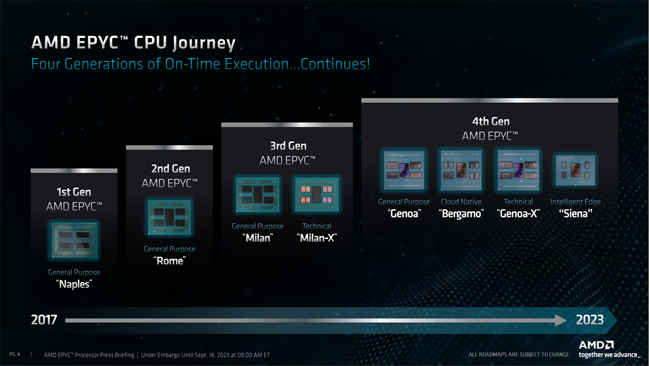
“The new EPYC 8004 Series processors extend AMD leadership in single socket platforms by offering excellent CPU energy efficiency in a package tuned to meet the needs of space and power-constrained infrastructure,” said Dan McNamara, senior vice president and general manager, Server Business, AMD. “AMD has delivered multiple generations of data centre processors that provide outstanding efficiency, performance, and innovative features. Now with our 4th Gen EPYC CPU portfolio complete, that leadership continues across a broad set of workloads – from enterprise and cloud, to intelligent edge, technical computing and more.”
AMD EPYC 8004 "Zen 4c" ProcessorsThe new AMD EPYC 8004 processors have been built primarily for single-socket platforms. They boast of up to 64 “Zen 4c” cores coupled with 6 channels of DDR5 memory, all fitting on a much smaller footprint in the form of the new SP6 socket. The SP6 socket is meant for CPUs with 4844 pins which is significantly lesser than SP5 which has 6096 pins. As for physical footprint, the SP6 socket takes up the same amount of space as the SP3 socket i.e. 58.5 x 75.4 mm. The combination of these specs makes the new Sienna platform a good choice for applications that have restrictions on space and power consumption. Speaking of power consumption, the new EPYC 8004 processor family has a minimum configurable TDP of 70 Watts going all the way up to 255 Watts.

The entire range of AMD EPYC 8004 processors are listed below:

One of the application areas where the EPYC 8004 series is designed for is in edge deployments. These setups, often characterised by smaller server nodes, stand to gain substantially in terms of energy efficiency. Several major OEMs and partners have already rolled out solutions, specifically tuned to exploit the new EPYC 8004 processors' unique capabilities. Dell Technologies, for instance, has debuted with the PowerEdge C6615 server. Ericsson, working on telecom solutions for Cloud RAN computation acceleration, especially crucial in managing the deluge of mobile network traffic, is also coming out with solutions.

Lenovo, on the other hand, has unveiled its premium edge-centric server, the ThinkEdge SE455 V3, aiming squarely at next-gen AI applications at the edge. The EPYC 8004 series is also being utilised by Microsoft Azure for sectors such as retail and manufacturing. Supermicro also unveiled the Supermicro H13 generation of WIO Servers utilising the EPYC 8004 series processors.
from Apps News https://ift.tt/XfTd9Ee
Comments
Post a Comment