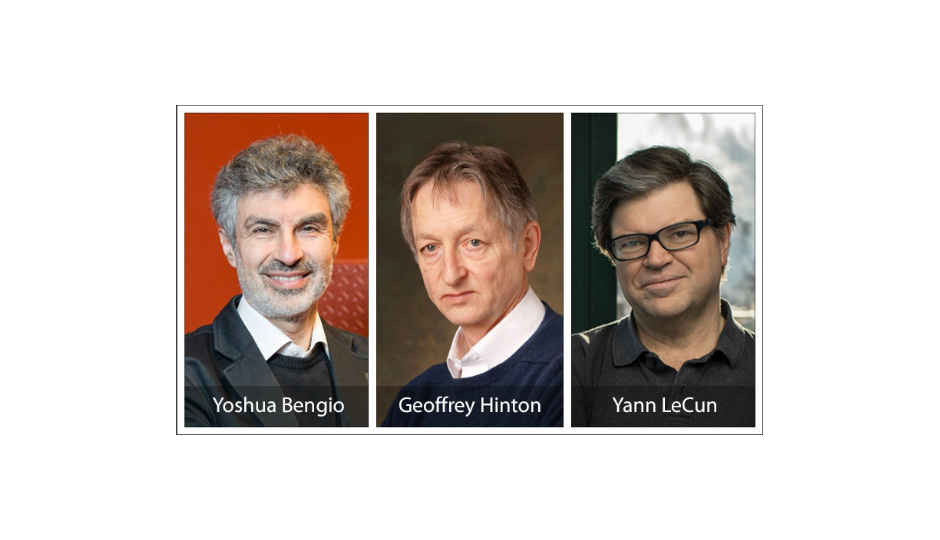
 Highlights: Yoshua Bengio, Geoffrey Hinton, and Yann LeCun awarded the Turing Award. The three researchers have been working and contributing to the field for more than 30 years. They identified new applications of neural networks and demonstrated their practical advantages. The Association for Computing Machinery (ACM) has announced the winners of 2018 Turing Award, which is also known as the “Nobel Prize of computing”. This time, the three ‘godfathers of AI,’ Yoshua Bengio, Geoffrey Hinton, and Yann LeCun are sharing the Turing Award “for conceptual and engineering breakthroughs that have made deep neural networks a critical component of computing.” The trio worked independently and together to develop conceptual foundations for the field. Via experiments, they identified new applications of neural networks and demonstrated their practical advantages. As we know, there are very few fields that are untouched by deep learning, neural networking and AI-based applications. Bengio is a professor at the University of Montreal and Scientific Director at Mila, Quebec’s Artificial Intelligence Institute. Hinton is VP and Engineering Fellow of Google, Chief Scientific Adviser of The Vector Institute, and University Professor Emeritus at the University of Toronto. LeCun is a professor at New York University and VP and Chief AI Scientist at Facebook. The Turing Award received by them also carries a $1 million prize, with financial support provided by Google. The award is named after the brilliant mathematician and scientist from Britain who laid the groundwork for modern computing. "Deep neural networks are responsible for some of the greatest advances in modern computer science, helping make substantial progress on long-standing problems in computer vision, speech recognition, and natural language understanding,” says Jeff Dean, Google Senior Fellow and SVP, Google AI. “At the heart of this progress are fundamental techniques developed starting more than 30 years ago by this year's Turing Award winners, Yoshua Bengio, Geoffrey Hinton, and Yann LeCun. By dramatically improving the ability of computers to make sense of the world, deep neural networks are changing not just the field of computing, but nearly every field of science and human endeavor." The concept of using neural networks so that computers are able to recognise patterns was introduced in the 1980s. However, LeCun, Hinton and Bengio were among a small group of researchers who remained committed to the development of the technology by the early 2000s. Over a period of 30 years, the researchers are said to have developed the techniques that led to accelerated growth in the field of computer vision, speech recognition and machine translation. Related Reads: IBM's machine learning model can detect Alzheimer's, slow down its progression This eerie website produces fake people using AI every time you refresh it!
from Latest Technology News https://ift.tt/2OCYAKZ
Comments
Post a Comment